Author Archive
Not Saying We Told You So …
The cover story of today’s Time Magazine Special Report agrees with our long-standing call for Medicare to negotiate drug prices and lower the age of Medicare eligibility. Even the CMS Medicare Director agrees that Medicare should negotiate what it pays for drugs. Just seven years ago Medicare didn’t even have a drug benefit – now it’s the largest buyer of drugs in the world!
Congress: It’s time to repeal the Bush-era prohibition against Medicare negotiating on behalf of all its customers. That’s how to drive costs down for Medicare, older people, people with disabilities, and taxpayers.
Wal-Mart does it – Medicare should too!
Judge Approves Settlement in Jimmo vs. Sebelius After Court Hearing
The Center for Medicare Advocacy, along with its co-counsel Vermont Legal Aid are pleased that the Settlement Agreement in the Medicare Improvement Standard case, Jimmo v. Sebelius, was approved January 24, 2013 at the conclusion of a scheduled fairness hearing, marking a critical step forward for thousands of beneficiaries nationwide.
The plaintiffs joined with the named defendant, Secretary of Health and Human Services Kathleen Sebelius, in asking the federal judge to approve the settlement of the case. With only one written comment received, and no class members appearing at the fairness hearing to question the settlement, Chief Judge Christina Reiss granted the motion to approve the Settlement Agreement on the record, while retaining jurisdiction to enforce the agreement in the future, as requested by the parties.
“We are not surprised but are very pleased that the judge ruled the settlement is fair, reasonable and adequate,” said Gill Deford, Litigation Director of the Center for Medicare Advocacy. “This moment is a culmination of two years of hard work, in conjunction with partners and advocates, to ensure that those who need health services covered under the Medicare law are not denied based on an illegal, outdated rule of thumb.”
With the settlement now officially approved, the Centers for Medicare & Medicaid Services (CMS) is tasked with revising its Medicare Benefit Policy Manual and numerous other policies, guidelines and instructions to ensure that Medicare coverage is available for skilled maintenance services in the home health, nursing home and outpatients settings. CMS must also develop and implement a nationwide education campaign for all who make Medicare determinations to ensure that beneficiaries with chronic conditions are not denied coverage for critical services because their underlying conditions will not improve.
“It is important to note that the Settlement Agreement standards for Medicare coverage of skilled maintenance services apply now – while CMS works on policy revisions and its education campaign,” said Judith Stein, Executive Director, Center for Medicare Advocacy. “We’ve been hearing from beneficiaries who are still being denied Medicare coverage based on an Improvement Standard. Coverage should be available now for people who need skilled maintenance care and meet any other qualifying Medicare criteria. This is the law of the land – agreed to by the federal government and approved by the federal judge. We encourage people to appeal should they be denied Medicare for skilled maintenance nursing or therapy because they are not improving.”
For people needing assistance with appeals, the Center for Medicare Advocacy has self-help materials available on its website, www.medicareadvocacy.org. This information can help individuals understand proper coverage rules and learn how to contest Medicare denials for outpatient, home health, or skilled nursing facility care.
“It is exciting to know that by this time next year, Medicare policies will clearly state that coverage for skilled maintenance nursing and therapy is available, and that a beneficiary’s access to coverage does not depend on the potential for improvement, but rather on the need for skilled care,” continued Stein.
To speak with a representative of the Center for Medicare Advocacy, please contact Lauren Weybrew at lweybrew@douglasgould.com or 914-833-7093. Learn more about the Center for Medicare Advocacy at www.medicareadvocacy.org
Getting the Right Bad Guys For Defrauding Medicare
Yesterday the U.S. Department of Justice indicted a Texas doctor and six others for defrauding Medicare and Medicaid of $375 million. The doctor ordered home health care services that were unnecessary and never even delivered to Medicare beneficiaries. We agree that’s outrageous.
Catching these criminals is good news for the federal government, taxpayers, and Medicare beneficiaries – such massive fraud is exactly the type of waste in Medicare that needs to stop.
However, as good as this news is for Medicare, we have to ask: how does Medicare pay out hundreds of millions in fraudulent home health claims over half a decade, while denying home health coverage for our 80-year-old client in Maine with paraplegia?
Ms. M’s doctors ordered skilled nursing for wound care and physical therapy to maintain her ability to use her wheelchair in her home. She has a legitimate need for home health services, but the only home health agency in her area claims the Medicare agency will charge it with fraud if it bills Medicare, because she won’t improve. This goes directly against the Medicare regulations, which allow for services designed to maintain her level of function. Unfortunately this “Improvement Standard” is so ingrained in Medicare contractors and providers, that providers fear being accused of fraud if they bill for these legitimate services.
We are buoyed by the successful investigation by law enforcement in the Texas case. Such victories should leave more money for people like our client, who have legitimate home health needs that are coverable by Medicare.
Perhaps Someone IS Listening
The NY Times editorial of 12/18/2011, “Working with Medicare,” picks up on some ideas the Center has been espousing for years:
- Negotiate drug prices for Medicare beneficiaries.
- Let the Affordable Care Act do its job.
- Be careful regarding private plans, premium support and too much cost-shifting to beneficiaries.
- The REAL solution to Medicare costs lies in addressing health care costs in general.
Medicare “Reform” – Beware the Wolf in Sheep’s Clothing
This week, Rep. Paul Ryan (R-WI) and Sen. Ron Wyden (D-OR) outlined yet another effort to privatize Medicare; a twist on Rep. Ryan’s voucher plan from earlier this year.
The new proposal would supposedly “preserve” the traditional Medicare program, but force it to compete with private plans. Similar to the earlier Ryan voucher plan, which the Congressional Budget Office estimated would cost Medicare beneficiaries twice as much as traditional Medicare, this one is based on the flawed assumption that private plans will save Medicare money through competition and innovation. The belief that privatization will drive down costs is not based in fact.
On the contrary, private plans have not saved Medicare money, and often cost more than traditional Medicare. In fact, traditional Medicare — not private plans — has been the leader in innovations to keep health costs down and increase quality.
Under the latest Ryan privatization plan, beneficiaries would have a voucher to purchase a health plan (including traditional Medicare), and there would be a cap on the overall amount of Medicare spending per beneficiary. If a plan (including traditional Medicare) cost more than the voucher amount, then the beneficiary would have to pay the difference between the actual price and the voucher.
If traditional Medicare is forced to compete with private, for-profit plans, as Ryan proposes, private plans will work to minimize their spending, and woo the least costly beneficiaries. If beneficiaries that are more expensive to treat remain in traditional Medicare, it will be at a built-in competitive disadvantage, and might well become unsustainable.
The math is pretty simple. If beneficiaries pay more for health care, the federal government will save money. That’s where these federal savings come from. But this approach won’t do anything to reduce overall health care spending, which is the real problem. Instead, it will likely lead to reduction in benefits and increase cost-sharing for Medicare beneficiaries. Don’t be fooled into thinking this proposal protects and preserves Medicare – it eliminates a unified program.
Traditional Medicare has changed dramatically since its inception in 1965. It has been a cost-effective health care insurance model leading to innovation, access to care and economic security. But Medicare has been complicated and made more expensive by adding layers of private options. Further, as Medicare becomes more and more fragmented and traditional Medicare loses enrollment, it loses its bargaining power over health care costs and its ability to create innovations in the broader health system.
Untethered from the overspending and complexities that have been foisted on Medicare by private plans and non-negotiable drug prices, it could once again be a model, for affordable health insurance. Traditional Medicare needs to be strengthened with fewer, not more private options.
Medigap – Fact & Fiction
 Nearly one in five Medicare beneficiaries rely on Medicare Supplemental insurance policies (Medigap) to fill in the gaps of some of their Medicare coverage. As noted by the Kaiser Family Foundation, “Medigap policies help shield beneficiaries from sudden, relatively high out-of-pocket costs due to an unpredictable medical event, and also allow beneficiaries to more accurately budget their health care expenses, which is important to a population living on a fixed income” (Kaiser Family Foundation, “Medigap Reform: Setting the Context” Sept. 2011; http://www.kff.org/medicare/8235.cfm).
Unfortunately, among the proposals raised to achieve savings for Medicare as part of ongoing debt and deficit reduction talks, some policy-makers have suggested changing the way Medigap policies are structured. Under the assumption that charging beneficiaries more upfront will deter them from using unnecessary medical care, these proposals seek to increase Medigap deductibles and other cost-sharing. Such proposals are found in the Simpson-Bowles Debt Reduction Commission proposal, the President’s Plan for Economic Growth and Deficit Reduction, and have been echoed in the media. (See, e.g., a recent Washington Post editorial “Mind the Medigap” October 1, 2011.)
MYTH: Eliminating First-Dollar Medigap Coverage Will Lead To Beneficiaries Choosing Only Necessary, “Higher Value” Health Care Services
Many of the proposals to reform Medigap coverage aim to achieve Medicare savings by creating “financial incentives for newly eligible beneficiaries to seek high-value health care services.” (See, for example, the President’s Plan for Economic Growth.) However, as discussed in our recent CMA Alert, many so-called cost-saving measures are based on the misguided assumption that greater out-of-pocket expenses will lead to more reasonable decisions about obtaining various types of unnecessary or “low-value” medical care. (See CMA Alert at: http://www.medicareadvocacy.org/2011/09/the-presidents-plan-for-economic-growth-and-deficit-reduction-a-first-look-at-the-impact-on-medicare/.)
On the contrary, these proposals would at best fail to steer people toward high-value services and, at worst, would charge people more for obtaining needed health care, or deter them from seeking care altogether.
FACT: As Cost-Sharing Goes Up, Utilization of Services – Both Necessary and Unnecessary – Goes Down.
Raising cost-sharing for beneficiaries will discourage utilization of health care, including necessary services. The National Association of Insurance Commissioners (NAIC), the organization of state insurance regulators who oversee Medigap plans, recently warned of just such dire consequences:
It is important to note that the proposed changes will impact cost-sharing coverage for “medically necessary” services. By contract, Medigap policies only pay cost-sharing for items and services that Medicare itself has already determined to be medically necessary. The NAIC is concerned that the effects of this proposal will result in many seniors foregoing needed medical care because they cannot afford the care resulting in more costs to the Medicare program later on. Additionally, the proposal will simply shift more costs onto seniors (who by and large are not wealthy) and not address the underlying cause of increased medical costs. (Emphasis added.)
National Association of Insurance Commissioners, Letter to the Joint Committee on Deficit Reduction (September 21, 2011), http://www.naic.org/documents/committees_ex_grlc_
110921_letter_murray_hensarling_medigap_first_dollar.pdf.)
Raising the Medicare Eligibility Age Will Actually INCREASE Costs
Policymakers and pundits continue to propose Medicare changes that would have severe repercussions for beneficiaries and their families. These proposals will continue to make news as deficit discussions heat up. Too often, however, they are based on false information, which is repeated as fact by the media, pundits and policymakers. We aim to correct public misinformation about Medicare.
Medicare Works. For 46 years it has opened doors to necessary care for hundreds of millions of older and disabled people, and enhanced economic security for beneficiaries and their families. Informed Americans need to know the truth about the program and the people it serves.
Did you know?
According to the Center on Budget and Policy Priorities (www.cbpp.org) that “Raising Medicare’s eligibility age from 65 to 67, which the new Joint Select Committee will likely consider this fall as a deficit-reduction measure, would not only fail to constrain health care costs across the economy; it would increase them.
While this proposal would save the federal government money, it would do so by shifting costs to most of the 65- and 66-year-olds who would lose Medicare coverage, to employers that provide health coverage for their retirees, to Medicare beneficiaries, to younger people who buy insurance through the new health insurance exchanges, and to states.
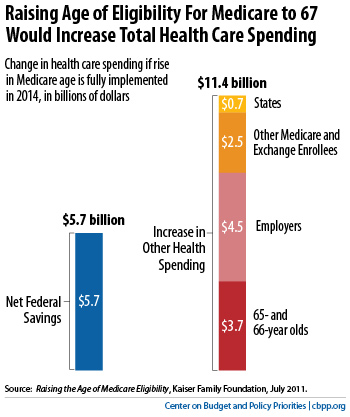
View the full report at: http://www.cbpp.org/cms/index.cfm?fa=view&id=3564 or http://www.cbpp.org/files/8-23-11health.pdf 7pp.
We’re Not the Only Ones Saying It: Let ACA Work!
As the Center has written, letting the Affordable Care Act do its job is a key component to reducing rising health care costs. Lawmakers appointed to the “Super Committee,” tasked with finding $1.5 trillion in deficit-reductions, will be considering various options to meet their budgeting goals. While doing so, we urge them to heed the words of Paul Van de Water of the Center on Budget and Policy Priorities, who writes:
“The Affordable Care Act (ACA) holds the potential to vastly improve Medicare’s long-term financial outlook…These reforms will take time to plan, test, and implement. But they can succeed only if we give them a chance, and that won’t happen if health reform opponents succeed in repealing them.” (Read the rest of the Van de Water’s blog at: http://www.offthechartsblog.org/the-%E2%80%9Csupercommittee%E2%80%9D-and-medicare/)
Support health care reform and reasoned approaches to our national budget concerns. Let ACA work!
Medicare Facts & Fiction: 3 More Lessons to Combat Medicare Spin
Congress continues to propose Medicare changes that will have severe repercussions for beneficiaries and their families. Policymakers and pundits are feeding the media and the public misinformation about Medicare. The truth is, most people with Medicare are low-income and most pay more for health care than other insured Americans. Nonetheless, Medicare Works. For 46 years it has opened doors to necessary care for millions of older people, people with disabilities, and their families.
Did you know?
- Medicare beneficiaries already spend a disproportionate share of their income on health expenses. Health expenses accounted for nearly 15% of Medicare household budgets in 2009, on average – three times the percentage of health spending among non-Medicare households (Kaiser Family Foundation Data Spotlight: Health Care on a Budget, June 2011)
- The financial burden of health care costs is greatest for Medicare beneficiaries ages 85 and older, those in relatively poor health, those with low or modest incomes, and those with Medigap supplemental policies (Kaiser Family Foundation Data Spotlight: How Much Skin in the Game is Enough?, June 2011)
- Half of all Medicare beneficiaries had incomes below $22,000 in 2010; less than 1% had incomes over $250,000
- Median per capita income declines with age, and is lower for black, Hispanic, and unmarried Medicare beneficiaries (Kaiser Family Foundation Data Spotlight: Projecting Income and Assets, June 2011)
- Raising the age of Medicare eligibility to 67, as has been proposed recently, will not produce significant savings: according to the Kaiser Family Foundation, most savings to the Medicare program would be off-set by other federal expenditures, and there would be a net increase in out of pocket costs for those age 65 and 66 who would otherwise have been covered by Medicare (Kaiser Family Foundation, Raising the Age of Medicare Eligibility, July 2011)
Surely there are better ways to save money than by piling more onto an already burdened population?

 CMA Health Policy Blog