Posts filed under ‘Deficit Reduction’
Six Solutions for Medicare Solvency and Reducing the Deficit
As lawmakers debate the future of Medicare as part of broader efforts to address the federal deficit, proposals have emerged that would have severe repercussions for beneficiaries and their families.[1] Sound solutions that would protect Medicare coverage while reducing costs to taxpayers have not been seriously addressed. The six solutions we propose would accomplish both of these goals.
These solutions, unlike many current proposals, do not shift costs to beneficiaries or completely restructure the Medicare program. They promote choice and competition while shoring up the solvency of Medicare. Adopting these solutions would be a responsible step in reducing our deficit the right way.
1. Negotiate Drug Prices with Pharmaceutical Companies
The Medicare prescription drug law passed in 2003 prohibits the Secretary of Health and Human Services from negotiating prices with pharmaceutical companies. These companies gained 47 million customers when Medicare began covering prescription drugs, but they did not have to adjust their prices in return. Requiring the Secretary to negotiate drug prices for Medicare would save taxpayers billions of dollars – potentially over $200 billion over ten years.[2] Taxpayers currently pay nearly 70% more for drugs in the Medicare program than through the Veteran’s Administration, which has direct negotiating power.[3] Savings realized from reducing Medicare drug cuts could be used to improve benefits for beneficiaries and reduce the deficit.
2. Stop Paying Private Medicare Plans Anything More Than Traditional Medicare
According to the Medicare Payment Advisory Commission (MedPAC), Medicare pays, on average, 10% more for beneficiaries enrolled in private insurance (Medicare Advantage or MA plans) than for comparable beneficiaries enrolled in traditional Medicare.[4] Despite these extra payments, beneficiaries in private plans who are in poor health, or who have chronic conditions, often have more limitations on coverage than they would under traditional Medicare.[5]
A large portion of the overpayments made to private plans actually goes to insurers rather than to benefit Medicare beneficiaries.[6] Although the Affordable Care Act (ACA) changed the payment formula for Medicare Advantage plans, some plans will continue to be paid as much as 115% of the average traditional Medicare payment rate for their county when the new rates are fully implemented. MedPAC estimates that by 2017Medicare Advantage payment benchmarks will average 101% of traditional Medicare. ACA also provides additional payments for plans that receive high quality ratings, increasing the likelihood that some MA plans will continue to be paid more than under traditional Medicare. Reducing private MA payments to 100% of traditional Medicare, as MedPAC proposed before the enactment of ACA, will increase the solvency of the Medicare program and curb costs for taxpayers. Private plans simply should not receive higher pay than traditional Medicare.
3. Include a Drug Benefit in Traditional Medicare
Offering a drug benefit in traditional Medicare would give beneficiaries a choice they do not now have, encourage people to stay in traditional Medicare, and save money for taxpayers. It would also provide an alternative to unchecked private plans that leave many with unexpected high out-of-pocket costs. A drug benefit in traditional Medicare would protect beneficiaries against expensive and sometimes abusive marketing practices. Further, traditional Medicare’s lower administrative costs could free up money for quality care, would result in lower drug prices for beneficiaries, and save taxpayers over $20 billion a year.[7]
4. Extend Medicaid Drug Rebates to Medicare Beneficiaries Who Are Dually Eligible or Part D Low-Income Subsidy Participants
Dual eligibles (people eligible for both Medicare and Medicaid) comprise one-fourth of all Medicare drug users, and are among the most costly beneficiaries. Because Medicare, rather than Medicaid, covers most of their drugs and because Medicare cannot negotiate drug prices, their drugs are not eligible for the same rebates as they would be under the traditional Medicaid program. Extending these rebates for dually eligible people as well as for those who qualify for the Part D Low-Income Subsidy – the poorest Medicare beneficiaries – would save approximately $135 billion over ten years.[8]
5. Lower the Age of Medicare Eligibility
People between 55 and 65 who are not disabled are currently unable to enroll in Medicare. Lowering the age of eligibility to enroll this healthier population in the Medicare program would add revenue from people who will likely need less care and fewer services than older and disabled enrollees.
6. Let the Affordable Care Act Do Its Job
The Affordable Care Act includes many measures to control costs as well as models for reform that will increase the solvency of the Medicare program and lower the deficit while protecting Medicare’s guaranteed benefits. The Congressional Budget Office estimates that repealing or defunding ACA would add $230 billion to the deficit while ignoring the real issue of rising overall health care costs, which contribute heavily to the growing national debt. ACA includes strong measures to allow CMS to combat fraud, waste, and abuse that will bring down costs, as well as a variety of pilot and demonstration projects that aim to bring better care and quality to beneficiaries.[9] The bipartisan Bowles-Simpson Deficit Commission recommended that these projects be implemented as quickly as possible.[10] Allowing ACA to do its job will create a foundation on which to build by improving care and holding down costs for taxpayers.
Conclusion
“Protecting Medicare” by shifting costs from the federal government to beneficiaries and their families – whether through a voucher program or spending caps or other draconian measures – is a perversion of Medicare’s original intent: to protect older people and their families from illness and financial ruin due to health care costs. The Center for Medicare Advocacy’s Six Solutions promote the financial welfare of Medicare and the country, without doing so at the expense of older and disabled people.
[1]See previous Alerts from the Center, “Why Medicaid Matters to Medicare Beneficiaries and Their Families”, “What Happens to Current Nursing Home Residents if House Budget Resolution Becomes Law?”
[2]National Committee to Preserve Social Security and Medicare, available at http://www.ncpssm.org/pdf/price_negotiation_part_d.pdf
[3]Center for Economic and Policy Research, “Negotiating Prices with Drug Companies Could Save Medicare $30 Billion”, March 2007, available at http://www.cepr.net/index.php/press-releases/press-releases/negotiating-prices-with-drug-companies-could-save-medicare-30-billion.
[4]MedPAC, Report to the Congress, March 2011, Chapter 12 (March 2011), available at http://www.medpac.gov/documents/Mar11_EntireReport.pdf.
[5] Neuman P. Medicare Advantage: Key Issues and Implications for Beneficiaries. Testimony before the House Committee on the Budget, United States House of Representatives, June 28, 2007, available at http://www.allhealth.org/briefingmaterials/NeumanTestimony-830.pdf,
[6] Medicare Payment Advisory Commission. March 2009 Report to Congress, Chapter 3: The Medicare Advantage Program. P. 251-253, available at http://www.medpac.gov/chapters/Mar09_Ch03.pdf.
[7]Senator Dick Durbin, available at http://durbin.senate.gov/public/index.cfm/pressreleases?ID=555cc1e8-cc54-4ead-9d85-d5e6275b3789.
[8]Office of Management and Buget Congressional Budget Office, Living Within Our Means (September, 2011); Letter to Honorable Charles Rangel, available at http://www.cbo.gov/ftpdocs/104xx/doc10464/hr3200.pdf
[9]See previous Alert from the Center, “Combating Fraud, Waste, and Abuse in Health Care.”
[10]The National Commission on Fiscal Responsibility and Reform, “The Moment of Truth,” December 2010.
Raising the Medicare Eligibility Age Will Actually INCREASE Costs
 Policymakers and pundits continue to propose Medicare changes that would have severe repercussions for beneficiaries and their families. These proposals will continue to make news as deficit discussions heat up. Too often, however, they are based on false information, which is repeated as fact by the media, pundits and policymakers. We aim to correct public misinformation about Medicare.
Medicare Works. For 46 years it has opened doors to necessary care for hundreds of millions of older and disabled people, and enhanced economic security for beneficiaries and their families. Informed Americans need to know the truth about the program and the people it serves.
Did you know?
According to the Center on Budget and Policy Priorities (www.cbpp.org) that “Raising Medicare’s eligibility age from 65 to 67, which the new Joint Select Committee will likely consider this fall as a deficit-reduction measure, would not only fail to constrain health care costs across the economy; it would increase them.
While this proposal would save the federal government money, it would do so by shifting costs to most of the 65- and 66-year-olds who would lose Medicare coverage, to employers that provide health coverage for their retirees, to Medicare beneficiaries, to younger people who buy insurance through the new health insurance exchanges, and to states.
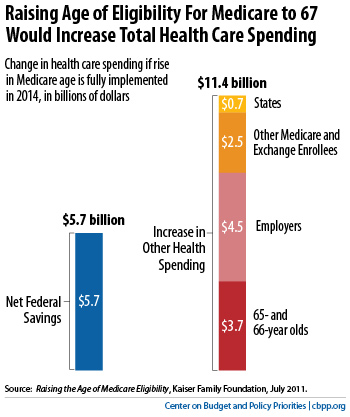
View the full report at: http://www.cbpp.org/cms/index.cfm?fa=view&id=3564 or http://www.cbpp.org/files/8-23-11health.pdf 7pp.
Some Reasonable Ways to Save Medicare Dollars
With lots of attention on the upcoming debt-reduction “Super Committee,” many ideas about saving federal dollars are in the air, not the least of which include restructuring Medicare. Some of these ideas are sound, others are not. For a discussion of some reasonable ideas about Medicare that will not simply shift more costs to beneficiaries, see this New York Times Op-Ed piece written by Dr. Ezekiel J. Emanuel and Professor Jeffrey B. Liebman. http://www.nytimes.com/2011/08/23/opinion/cut-medicare-help-patients.html?emc=tnt&tntemail1=y
While we disagree that “cutting Medicare” is a foregone conclusion, this article argues for eliminating Medicare coverage for tests, treatments and procedures that don’t work, and states that the Affordable Care Act should be left alone to do its job of producing higher quality, more efficient care. Across the board cuts aren’t smart, and cost-shifting to beneficiaries – including raising the age of Medicare eligibility – is not the right approach. We agree with these points. (IF the necessity for a given procedure and eligibility for coverage is decided based on each individual’s actual circumstances.)
For additional ideas of how to achieve savings in the Medicare program without gouging beneficiaries or backtracking on its promise, see the Center for Medicare Advocacy’s suggested Six Solutions. http://www.medicareadvocacy.org/2011/06/so-what-would-you-do-real-solutions-for-medicare-solvency-and-reducing-the-deficit/
We’re Not the Only Ones Saying It: Let ACA Work!
As the Center has written, letting the Affordable Care Act do its job is a key component to reducing rising health care costs. Lawmakers appointed to the “Super Committee,” tasked with finding $1.5 trillion in deficit-reductions, will be considering various options to meet their budgeting goals. While doing so, we urge them to heed the words of Paul Van de Water of the Center on Budget and Policy Priorities, who writes:
“The Affordable Care Act (ACA) holds the potential to vastly improve Medicare’s long-term financial outlook…These reforms will take time to plan, test, and implement. But they can succeed only if we give them a chance, and that won’t happen if health reform opponents succeed in repealing them.” (Read the rest of the Van de Water’s blog at: http://www.offthechartsblog.org/the-%E2%80%9Csupercommittee%E2%80%9D-and-medicare/)
Support health care reform and reasoned approaches to our national budget concerns. Let ACA work!
Medicare Facts & Fiction: 3 More Lessons to Combat Medicare Spin
Congress continues to propose Medicare changes that will have severe repercussions for beneficiaries and their families. Policymakers and pundits are feeding the media and the public misinformation about Medicare. The truth is, most people with Medicare are low-income and most pay more for health care than other insured Americans. Nonetheless, Medicare Works. For 46 years it has opened doors to necessary care for millions of older people, people with disabilities, and their families.
Did you know?
- Medicare beneficiaries already spend a disproportionate share of their income on health expenses. Health expenses accounted for nearly 15% of Medicare household budgets in 2009, on average – three times the percentage of health spending among non-Medicare households (Kaiser Family Foundation Data Spotlight: Health Care on a Budget, June 2011)
- The financial burden of health care costs is greatest for Medicare beneficiaries ages 85 and older, those in relatively poor health, those with low or modest incomes, and those with Medigap supplemental policies (Kaiser Family Foundation Data Spotlight: How Much Skin in the Game is Enough?, June 2011)
- Half of all Medicare beneficiaries had incomes below $22,000 in 2010; less than 1% had incomes over $250,000
- Median per capita income declines with age, and is lower for black, Hispanic, and unmarried Medicare beneficiaries (Kaiser Family Foundation Data Spotlight: Projecting Income and Assets, June 2011)
- Raising the age of Medicare eligibility to 67, as has been proposed recently, will not produce significant savings: according to the Kaiser Family Foundation, most savings to the Medicare program would be off-set by other federal expenditures, and there would be a net increase in out of pocket costs for those age 65 and 66 who would otherwise have been covered by Medicare (Kaiser Family Foundation, Raising the Age of Medicare Eligibility, July 2011)
Surely there are better ways to save money than by piling more onto an already burdened population?
Medicare Facts & Fiction: 3 Quick Lessons to Combat Medicare Spin
Congress continues to propose Medicare changes that will have severe repercussions for beneficiaries and their families. Policymakers and pundits are feeding the media and the public misinformation about Medicare. The truth is, most people with Medicare are low-income and most pay more for health care than other insured Americans. Nonetheless, Medicare Works. For 46 years it has opened doors to necessary care for millions of older people, people with disabilities, and their families.
Did you know?
- The average income of Medicare beneficiaries is less than $22,000 per year.
- Medicare beneficiaries already pay more out-of-pocket for health care than people with other health insurance.
- Higher income people with Medicare already pay higher premiums for Medicare than other Medicare beneficiaries.
What’s Fair? Should we tax Millionaires or grandparents? Millionaires.
It’s Mediare’s Anniversary: Make Sure it Has Many More
The Center for Medicare Advocacy has represented older and disabled Medicare beneficiaries for over 25 years. We have seen the value of this time-honored program to our clients and their families. We have seen people with Medicare live better, more secure, longer lives. The 46th anniversary of Medicare, one of our country’s great successes, should not be tarnished by gutting the program for the next generation or changing its core structure, that holds the same promise for all of us, regardless of income. The universality of Medicare’s guaranteed benefits has been its hallmark and saving grace. Celebrate Medicare by preserving these time-tested values.
Hello Leaders: Are You Listening?
Medicaid Matters!
Medicare has received most of the headlines regarding proposals from Congress and the Administration to reduce the federal deficit and raise the federal debt ceiling. Proposals to restructure Medicaid have been receiving less attention than those about Medicare. But Medicaid, which serves nearly 60 million Americans − older people, people with disabilities, pregnant women, children and their families – may be in greater jeopardy than Medicare. The good news is that more than 50% of all Americans either have received services through Medicaid or have a friend or family member who has, so most Americans know something about Medicaid and its importance to them, their families and friends.
Medicare and Medicaid – Inextricably Intertwined
Nearly nine million low-income Medicare beneficiaries depend on Medicaid to help them pay Medicare’s significant premiums and cost-sharing and to pay for services erroneously denied or excluded from Medicare coverage, including nursing home care and community-based long-term supports and services. These beneficiaries are generally poorer and sicker than the general Medicare population. They comprise 21% of Medicare enrollees, and use 36% of Medicare dollars. They comprise 15% of Medicaid enrollees and use 40% of Medicaid dollars. Medicaid is critical to the health and well-being of these individuals and their families.
For these beneficiaries, Medicaid is necessary to cover:
- Medicare’s Out-of-Pocket Costs –Medicaid pays for all of Medicare’s cost-sharing for about four million Medicare beneficiaries and pays the Part B premium for more than eight million beneficiaries.
- Long-Term Care Supports and Services – More than 10 million people in the U.S. have long-term care needs and more than 80% of those people live in the community. Medicare pays for only about one-quarter of spending for long-term care. When family resources are exhausted or in need of additional support, Medicaid steps in.
- Nursing Facility Services –Medicaid pays some costs for 70% of all nursing home residents, most of whom are also eligible for Medicare.
- Home and Community-Based Services – Increasingly, Medicaid is paying for long-term care supports and services in the community in addition to paying for care in nursing facilities.
Real People Depend on Medicaid to Pay for Services Not Covered by Medicare or to Provide Coverage When Medicare is Denied
The Center for Medicare Advocacy represents thousands of dually eligible people who need help paying their Medicare cost-sharing or who have been denied Medicare coverage. These older and disabled people would go without necessary health care if they did not have Medicaid to help pay their Medicare out-of-pocket costs or to rely on when Medicare denies coverage – often erroneously.
Although our clients may eventually win coverage on appeal, the vast majority of dually eligible people lack representation, and do not appeal Medicare denials. They depend on Medicaid to pay for necessary health care. The ability to fall back on Medicaid when Medicare coverage is denied, or is no longer available, or does not cover the needed health service, is also a blessing for families. Without Medicaid, families of these older and disabled people would have to find the resources themselves to pay for their loved-ones’ care, see them go without the care they need, or try to provide it themselves.
Medicaid matters. Protect it – for the health of all Americans.

 CMA Health Policy Blog