Posts tagged ‘Deficit; Medicare’
CMA in the New York Times: Don’t Privatize Medicare
http://www.nytimes.com/2011/12/10/opinion/medicare-and-private-health-insurance.html
Medicare “Reform” – Beware the Wolf in Sheep’s Clothing
This week, Rep. Paul Ryan (R-WI) and Sen. Ron Wyden (D-OR) outlined yet another effort to privatize Medicare; a twist on Rep. Ryan’s voucher plan from earlier this year.
The new proposal would supposedly “preserve” the traditional Medicare program, but force it to compete with private plans. Similar to the earlier Ryan voucher plan, which the Congressional Budget Office estimated would cost Medicare beneficiaries twice as much as traditional Medicare, this one is based on the flawed assumption that private plans will save Medicare money through competition and innovation. The belief that privatization will drive down costs is not based in fact.
On the contrary, private plans have not saved Medicare money, and often cost more than traditional Medicare. In fact, traditional Medicare — not private plans — has been the leader in innovations to keep health costs down and increase quality.
Under the latest Ryan privatization plan, beneficiaries would have a voucher to purchase a health plan (including traditional Medicare), and there would be a cap on the overall amount of Medicare spending per beneficiary. If a plan (including traditional Medicare) cost more than the voucher amount, then the beneficiary would have to pay the difference between the actual price and the voucher.
If traditional Medicare is forced to compete with private, for-profit plans, as Ryan proposes, private plans will work to minimize their spending, and woo the least costly beneficiaries. If beneficiaries that are more expensive to treat remain in traditional Medicare, it will be at a built-in competitive disadvantage, and might well become unsustainable.
The math is pretty simple. If beneficiaries pay more for health care, the federal government will save money. That’s where these federal savings come from. But this approach won’t do anything to reduce overall health care spending, which is the real problem. Instead, it will likely lead to reduction in benefits and increase cost-sharing for Medicare beneficiaries. Don’t be fooled into thinking this proposal protects and preserves Medicare – it eliminates a unified program.
Traditional Medicare has changed dramatically since its inception in 1965. It has been a cost-effective health care insurance model leading to innovation, access to care and economic security. But Medicare has been complicated and made more expensive by adding layers of private options. Further, as Medicare becomes more and more fragmented and traditional Medicare loses enrollment, it loses its bargaining power over health care costs and its ability to create innovations in the broader health system.
Untethered from the overspending and complexities that have been foisted on Medicare by private plans and non-negotiable drug prices, it could once again be a model, for affordable health insurance. Traditional Medicare needs to be strengthened with fewer, not more private options.
Federal Judge Refuses To Dismiss Medicare Beneficiaries’ Challenge To The Medicare “Improvement Standard”
Plaintiffs have overcome a major hurdle in a lawsuit filed by the Center for Medicare Advocacy and Vermont Legal Aid on behalf of Medicare beneficiaries with long-term and chronic conditions. In a comprehensive 35-page decision, Chief Judge Christina Reiss refused the federal government’s request to throw out a lawsuit that seeks to end use of an illegal Improvement Standard to deny Medicare coverage. The Improvement Standard is a “rule of thumb” that Medicare uses to deny or terminate coverage to beneficiaries whose conditions are not improving. Jimmo v. Sebelius, Civil No. 5:11-CV-17 (D. VT. 10/25/20011).
“The Improvement Standard is the most unfair and harmful reason for Medicare denials,” stated Judith Stein, executive director of the Center for Medicare Advocacy. “It has a particularly devastating effect on patients with chronic conditions such as Multiple Sclerosis, Alzheimer’s disease, ALS, Parkinson’s disease, and paralysis.”
The lawsuit, which was filed in January of this year, was brought on behalf of a nationwide class of Medicare beneficiaries by six individual beneficiaries and seven national organizations representing people with chronic conditions.
In asking the court to dismiss the case, the government raised several arguments to contend that the court lacked jurisdiction over the plaintiffs’ claims. The government also argued that the plaintiffs failed to state a claim, namely, that there was no proof that the government was even applying such a policy as the Improvement Standard. Judge Reiss rejected that contention. She did agree, however, that the court lacked jurisdiction over one beneficiary plaintiff and one organizational plaintiff, but the case will go forward with the remaining eleven plaintiffs.
“Judge Reiss understands the core issue plaintiffs in this case seek to address,” stated Michael Benvenuto, attorney for plaintiffs from Vermont Legal Aid. “They are not seeking individual claim reviews; they are challenging a broad secret policy.”
“This is a great first step for these plaintiffs and for Medicare beneficiaries in general,” remarked Gill Deford, the lead attorney for the plaintiffs. “The Improvement Standard has been used for over 30 years to deprive hundreds of thousands of Medicare beneficiaries of coverage they desperately needed. This decision starts the process of ending that illegal policy.”
A Modest Medicare Proposal (As Suggested by a Reader)
Instead of raising the age of eligibility for Medicare, why don’t we just use Part D as a model and create a new Eligibility Donut Hole?
People ages 65 – 69 can keep their eligibility. But, between ages 70 and 85: Into the new Donut Hole. Eligibility for Medicare would end during this time – after all it’s these older people that start getting sick, so it’s the perfect time to stop paying for their health care. The new Donut Hole would save the government a ton of money!
Those who do make it through the Eligibility Donut Hole without Medicare, would once again become eligible at age 86. At that point most people only need “comfort measures” and their conditions usually won’t improve, so Medicare wouldn’t pay for their care anyway!
If the goal is to save money, a new Medicare Eligibiity Donut Hole is the way to go.
Class Warfare? Discuss.
To reduce the deficit, the President suggests we increase taxes for the 430,000 Americans who have incomes above $1 million. The Republican leadership (Boehner, Ryan, McConnell and Graham) say that’s class warfare. They say it’s unfair to balance the budget at the expense of these few rich people (0.3% of the population). Instead, they say, we should look to reduce spending – only. In particular, we should cut Medicaid and Medicare.
47 million older and disabled Americans are enrolled in Medicare. 58 million poor children, pregnant women, older and disabled people are enrolled in Medicaid.
Query: Why is it class warfare to tax a little more the few of us who are lucky enough to be millionaires, but it’s not class warfare to cut health care coverage for the vast number of us who are enrolled in Medicare and Medicaid? Discuss.
Medicare and Jobs: Not Mutually Exclusive!
The more people have health insurance, including Medicare, the more they stay healthy and are able to work. If health insurance is provided by Medicare or health care reform or any avenue outside the tired employer-based system, it reduces costs for employers and encourages hiring. Ask any employer.
Continuing to tie health insurance to employment only continues a system that COSTS jobs. It creates a disincentive for employers to hire. It creates an incentive for the new employment reality: Freelance, contract work, part-time, whatever you want to call the newly underemployed who do not have benefits and for whom employers do not pay into Medicare, Social Security, Unemployment, or Workers Comp. This is a big problem for everyone involved, including individual workers, their families, AND the solvency of important programs that Americans value and that have lifted generations out of poverty and provided fair access to health care.
Pay attention, people! We not only can have Medicare and jobs – we will have more jobs if we increase access to Medicare and health care. Don’t raid Medicare to pay for jobs. That will only reduce access to both.
Raising the Medicare Eligibility Age Will Actually INCREASE Costs
 Policymakers and pundits continue to propose Medicare changes that would have severe repercussions for beneficiaries and their families. These proposals will continue to make news as deficit discussions heat up. Too often, however, they are based on false information, which is repeated as fact by the media, pundits and policymakers. We aim to correct public misinformation about Medicare.
Medicare Works. For 46 years it has opened doors to necessary care for hundreds of millions of older and disabled people, and enhanced economic security for beneficiaries and their families. Informed Americans need to know the truth about the program and the people it serves.
Did you know?
According to the Center on Budget and Policy Priorities (www.cbpp.org) that “Raising Medicare’s eligibility age from 65 to 67, which the new Joint Select Committee will likely consider this fall as a deficit-reduction measure, would not only fail to constrain health care costs across the economy; it would increase them.
While this proposal would save the federal government money, it would do so by shifting costs to most of the 65- and 66-year-olds who would lose Medicare coverage, to employers that provide health coverage for their retirees, to Medicare beneficiaries, to younger people who buy insurance through the new health insurance exchanges, and to states.
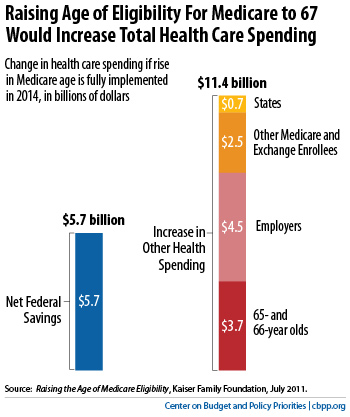
View the full report at: http://www.cbpp.org/cms/index.cfm?fa=view&id=3564 or http://www.cbpp.org/files/8-23-11health.pdf 7pp.
Some Reasonable Ways to Save Medicare Dollars
With lots of attention on the upcoming debt-reduction “Super Committee,” many ideas about saving federal dollars are in the air, not the least of which include restructuring Medicare. Some of these ideas are sound, others are not. For a discussion of some reasonable ideas about Medicare that will not simply shift more costs to beneficiaries, see this New York Times Op-Ed piece written by Dr. Ezekiel J. Emanuel and Professor Jeffrey B. Liebman. http://www.nytimes.com/2011/08/23/opinion/cut-medicare-help-patients.html?emc=tnt&tntemail1=y
While we disagree that “cutting Medicare” is a foregone conclusion, this article argues for eliminating Medicare coverage for tests, treatments and procedures that don’t work, and states that the Affordable Care Act should be left alone to do its job of producing higher quality, more efficient care. Across the board cuts aren’t smart, and cost-shifting to beneficiaries – including raising the age of Medicare eligibility – is not the right approach. We agree with these points. (IF the necessity for a given procedure and eligibility for coverage is decided based on each individual’s actual circumstances.)
For additional ideas of how to achieve savings in the Medicare program without gouging beneficiaries or backtracking on its promise, see the Center for Medicare Advocacy’s suggested Six Solutions. http://www.medicareadvocacy.org/2011/06/so-what-would-you-do-real-solutions-for-medicare-solvency-and-reducing-the-deficit/
We’re Not the Only Ones Saying It: Let ACA Work!
As the Center has written, letting the Affordable Care Act do its job is a key component to reducing rising health care costs. Lawmakers appointed to the “Super Committee,” tasked with finding $1.5 trillion in deficit-reductions, will be considering various options to meet their budgeting goals. While doing so, we urge them to heed the words of Paul Van de Water of the Center on Budget and Policy Priorities, who writes:
“The Affordable Care Act (ACA) holds the potential to vastly improve Medicare’s long-term financial outlook…These reforms will take time to plan, test, and implement. But they can succeed only if we give them a chance, and that won’t happen if health reform opponents succeed in repealing them.” (Read the rest of the Van de Water’s blog at: http://www.offthechartsblog.org/the-%E2%80%9Csupercommittee%E2%80%9D-and-medicare/)
Support health care reform and reasoned approaches to our national budget concerns. Let ACA work!
Medicare Facts & Fiction: 3 Quick Lessons to Combat Medicare Spin
Congress continues to propose Medicare changes that will have severe repercussions for beneficiaries and their families. Policymakers and pundits are feeding the media and the public misinformation about Medicare. The truth is, most people with Medicare are low-income and most pay more for health care than other insured Americans. Nonetheless, Medicare Works. For 46 years it has opened doors to necessary care for millions of older people, people with disabilities, and their families.
Did you know?
- The average income of Medicare beneficiaries is less than $22,000 per year.
- Medicare beneficiaries already pay more out-of-pocket for health care than people with other health insurance.
- Higher income people with Medicare already pay higher premiums for Medicare than other Medicare beneficiaries.
What’s Fair? Should we tax Millionaires or grandparents? Millionaires.

 CMA Health Policy Blog