Posts tagged ‘Fact and Fiction’
Scary Ryan Medicare Plan
The Center for Medicare Advocacy is a national leader for Medicare and the people it serves. “We have represented Medicare beneficiaries since 1986,” says Judith Stein, founder and executive director of the Center. “We’ve seen Medicare coverage save lives and bring peace of mind to thousands of families. We know how Medicare works and what keeps Medicare strong. Mr. Ryan’s plan sounds the death knell for Medicare,” continues Ms. Stein. “The private plans added to Medicare since 2003 have cost Medicare and all its beneficiaries dearly. Unfortunately, Mr. Ryan’s vision is to privatize Medicare.”
The Ryan plan would provide each beneficiary with a limited amount to purchase an individual private policy. The Ryan plan would gut the community Medicare program. It would reduce coverage and increase costs for seniors – while doing nothing to address the real problem of rising overall health costs.
“Medicare has dramatically increased access to health care and economic security for millions of older and disabled people and their families since 1965. Mr. Ryan’s plan puts all this in jeopardy. He purports to save Medicare – but will actually end the Medicare program as we know it.”
More Information:
CMA Heath Policy Post: “Medicare ‘Reform’ – Beware the Wolf in Sheep’s Clothing” at: https://cmahealthpolicy.com/2011/12/16/medicare-reform-beware-the-wolf-in-sheeps-clothing/
CMA Alert: “So What Would You Do? real Solutions for Medicare Solvency and Reducing the Deficit” at: http://www.medicareadvocacy.org/2011/06/09/so-what-would-you-do-real-solutions-for-medicare-solvency-and-reducing-the-deficit/
We All Lose – If The Supreme Court Strikes Down Health Reform
Millions of people will be left with limited or no access to health care if the Affordable Care Act (ACA) is overturned. This will include people of all ages − older and disabled people with Medicare, middle class families, children with asthma and other pre-existing conditions, and adults with on-going medical needs. At this time, when family incomes are stretched to the max, many people are unemployed, and fewer jobs provide health insurance, individuals and families all over the country will lose if the Court strikes down Health Care Reform.
Older and disabled people with Medicare will lose access to preventive health care, help paying for life-saving medications, and an annual health visit. Taxpayers will resume overpayments to private Medicare plans. Children with preexisting conditions will again be subject to discrimination by private health insurance companies. People who would have gained access to coverage under ACA, beginning in 2014, will lose out. This includes adults with pre-existing conditions, those with high out-of-pocket costs, and families with moderate incomes. Young adults who, thanks to ACA, have health coverage under their parents’ plans will also be in jeopardy.
In short, if the Court strikes down the law we all lose. The number of people with inadequate or no health insurance will rise – but those same people will still get sick and injured, and require care. And we will all pay, in emergency rooms, unpaid hospital bills, higher premiums – or simply by catching their illnesses.
Let’s hope the Supreme Court recognizes the national interest in making basic health insurance available to all. If it does, we will all feel better.
Save Medicare From Private Vouchers
Once again, Rep. Paul Ryan has reiterated his plan and commitment to “save” Medicare through priatization. (http://washingtonexaminer.com/opinion/op-eds/2012/05/medicare-two-paths-two-futures/568246) If only the logic of his plan was as clear as his determination to change Medicare into a set of capped vouchers. If passed, the popular community Medicare program would be replaced. Instead, individuals eligible for Medicare would get an annual alloawance to shop for their own insurance coverage.
Yet again, the Ryan plan would eliminate Medicare, not save it.
Affordable Care Act’s 2nd Anniversary: So Far, So Good
We are happy to celebrate the second anniversary of health care reform. Since the Affordable Care Act (ACA) became law in 2010, significant progress has been made to enhance access to health care for all Americans. This progress touches the lives of millions of American families.—from every state, and every walk of life. We look forward to the law’s full implementation in 2014.
Health care reform has already improved and strengthened Medicare. It’s helping older and disabled Americans in many ways, including:
1. Adding Medicare preventive health care services, usually at no cost, including an annual wellness visit, many cancer screenings, vaccines, smoking cessation and dietary counseling. This means people with Medicare can work to maintain their health and can recognize problems early, when treatment is most effective.
2. Increasing Medicare coverage for prescription drugs for people with the highest medication costs, by providing more coverage during the “Donut Hole” coverage gap. These benefits will continue to improve every year through 2020, when the “Donut Hole” will end, ensuring continued cost savings for older and disabled people.
3. Insisting that private Medicare Advantage plans provide real value to those who enroll, including appropriate Medicare coverage and quality customer service. Beginning in 2014, the law will also require these plans to spend at least 85% of the premiums they collect on medical care, rather than on excessive administrative costs and increased profits. The law also saves Medicare and taxpayers millions of dollars by ending wasteful overpayments to these private insurance companies.
These are just a few of the ways ACA insists on fair value in return for taxpayer dollars, while improving health care for older and disabled people. And this is just the beginning. If the Affordable Care Act is allowed to proceed as designed, it will continue to enhance access to quality health care, increase efficiency, and reduce costs to Medicare and taxpayers.
Spread the word about the value of the Affordable Care Act and the need to see it through to full implementation. Health care reform is good for Medicare, good for families, and good for the country. Let it work!
CMA in the New York Times: Don’t Privatize Medicare
http://www.nytimes.com/2011/12/10/opinion/medicare-and-private-health-insurance.html
CMA Responds to the NY Times: Don’t Privatize Medicare!
Dec. 4, 2011
The New York Times
620 Eighth Avenue
New York, NY 10018
To the Editor:
Your December 4, 2011 editorial (”What About Premium Support?” ) about changing Medicare into a voucher system wisely states many of the problems with public subsidies of private health insurance for Medicare beneficiaries. All such experiments have cost more and provided less value to those in need of coverage.
I have been an advocate for Medicare beneficiaries for almost 35 years. I’ve seen numerous forays into privatizing Medicare. Clinton-era plans, Medicare Plus Choice, Medicare Advantage: none of them have provided better coverage more cost-effectively than the traditional Medicare program.
I don’t recommend a private plan to my mother. That should be a good test for anyone championing premium support.
Additionally, ever-increasing private options have made Medicare too complex, especially given the very limited number of advocates available to help beneficiaries understand, choose and navigate the system.
Call it what you will, ”premium support” is the latest jingle for privatizing Medicare. It’s not a new or creative idea, and it will only add more costs and confusion. What we need is an objective look at what’s needed to encourage participation and cost efficiencies in traditional Medicare, not further adventures in privatization.
JUDITH STEIN
Executive Director
Center for Medicare Advocacy
Medigap – Fact & Fiction
 Nearly one in five Medicare beneficiaries rely on Medicare Supplemental insurance policies (Medigap) to fill in the gaps of some of their Medicare coverage. As noted by the Kaiser Family Foundation, “Medigap policies help shield beneficiaries from sudden, relatively high out-of-pocket costs due to an unpredictable medical event, and also allow beneficiaries to more accurately budget their health care expenses, which is important to a population living on a fixed income” (Kaiser Family Foundation, “Medigap Reform: Setting the Context” Sept. 2011; http://www.kff.org/medicare/8235.cfm).
Unfortunately, among the proposals raised to achieve savings for Medicare as part of ongoing debt and deficit reduction talks, some policy-makers have suggested changing the way Medigap policies are structured. Under the assumption that charging beneficiaries more upfront will deter them from using unnecessary medical care, these proposals seek to increase Medigap deductibles and other cost-sharing. Such proposals are found in the Simpson-Bowles Debt Reduction Commission proposal, the President’s Plan for Economic Growth and Deficit Reduction, and have been echoed in the media. (See, e.g., a recent Washington Post editorial “Mind the Medigap” October 1, 2011.)
MYTH: Eliminating First-Dollar Medigap Coverage Will Lead To Beneficiaries Choosing Only Necessary, “Higher Value” Health Care Services
Many of the proposals to reform Medigap coverage aim to achieve Medicare savings by creating “financial incentives for newly eligible beneficiaries to seek high-value health care services.” (See, for example, the President’s Plan for Economic Growth.) However, as discussed in our recent CMA Alert, many so-called cost-saving measures are based on the misguided assumption that greater out-of-pocket expenses will lead to more reasonable decisions about obtaining various types of unnecessary or “low-value” medical care. (See CMA Alert at: http://www.medicareadvocacy.org/2011/09/the-presidents-plan-for-economic-growth-and-deficit-reduction-a-first-look-at-the-impact-on-medicare/.)
On the contrary, these proposals would at best fail to steer people toward high-value services and, at worst, would charge people more for obtaining needed health care, or deter them from seeking care altogether.
FACT: As Cost-Sharing Goes Up, Utilization of Services – Both Necessary and Unnecessary – Goes Down.
Raising cost-sharing for beneficiaries will discourage utilization of health care, including necessary services. The National Association of Insurance Commissioners (NAIC), the organization of state insurance regulators who oversee Medigap plans, recently warned of just such dire consequences:
It is important to note that the proposed changes will impact cost-sharing coverage for “medically necessary” services. By contract, Medigap policies only pay cost-sharing for items and services that Medicare itself has already determined to be medically necessary. The NAIC is concerned that the effects of this proposal will result in many seniors foregoing needed medical care because they cannot afford the care resulting in more costs to the Medicare program later on. Additionally, the proposal will simply shift more costs onto seniors (who by and large are not wealthy) and not address the underlying cause of increased medical costs. (Emphasis added.)
National Association of Insurance Commissioners, Letter to the Joint Committee on Deficit Reduction (September 21, 2011), http://www.naic.org/documents/committees_ex_grlc_
110921_letter_murray_hensarling_medigap_first_dollar.pdf.)
Six Solutions for Medicare Solvency and Reducing the Deficit
As lawmakers debate the future of Medicare as part of broader efforts to address the federal deficit, proposals have emerged that would have severe repercussions for beneficiaries and their families.[1] Sound solutions that would protect Medicare coverage while reducing costs to taxpayers have not been seriously addressed. The six solutions we propose would accomplish both of these goals.
These solutions, unlike many current proposals, do not shift costs to beneficiaries or completely restructure the Medicare program. They promote choice and competition while shoring up the solvency of Medicare. Adopting these solutions would be a responsible step in reducing our deficit the right way.
1. Negotiate Drug Prices with Pharmaceutical Companies
The Medicare prescription drug law passed in 2003 prohibits the Secretary of Health and Human Services from negotiating prices with pharmaceutical companies. These companies gained 47 million customers when Medicare began covering prescription drugs, but they did not have to adjust their prices in return. Requiring the Secretary to negotiate drug prices for Medicare would save taxpayers billions of dollars – potentially over $200 billion over ten years.[2] Taxpayers currently pay nearly 70% more for drugs in the Medicare program than through the Veteran’s Administration, which has direct negotiating power.[3] Savings realized from reducing Medicare drug cuts could be used to improve benefits for beneficiaries and reduce the deficit.
2. Stop Paying Private Medicare Plans Anything More Than Traditional Medicare
According to the Medicare Payment Advisory Commission (MedPAC), Medicare pays, on average, 10% more for beneficiaries enrolled in private insurance (Medicare Advantage or MA plans) than for comparable beneficiaries enrolled in traditional Medicare.[4] Despite these extra payments, beneficiaries in private plans who are in poor health, or who have chronic conditions, often have more limitations on coverage than they would under traditional Medicare.[5]
A large portion of the overpayments made to private plans actually goes to insurers rather than to benefit Medicare beneficiaries.[6] Although the Affordable Care Act (ACA) changed the payment formula for Medicare Advantage plans, some plans will continue to be paid as much as 115% of the average traditional Medicare payment rate for their county when the new rates are fully implemented. MedPAC estimates that by 2017Medicare Advantage payment benchmarks will average 101% of traditional Medicare. ACA also provides additional payments for plans that receive high quality ratings, increasing the likelihood that some MA plans will continue to be paid more than under traditional Medicare. Reducing private MA payments to 100% of traditional Medicare, as MedPAC proposed before the enactment of ACA, will increase the solvency of the Medicare program and curb costs for taxpayers. Private plans simply should not receive higher pay than traditional Medicare.
3. Include a Drug Benefit in Traditional Medicare
Offering a drug benefit in traditional Medicare would give beneficiaries a choice they do not now have, encourage people to stay in traditional Medicare, and save money for taxpayers. It would also provide an alternative to unchecked private plans that leave many with unexpected high out-of-pocket costs. A drug benefit in traditional Medicare would protect beneficiaries against expensive and sometimes abusive marketing practices. Further, traditional Medicare’s lower administrative costs could free up money for quality care, would result in lower drug prices for beneficiaries, and save taxpayers over $20 billion a year.[7]
4. Extend Medicaid Drug Rebates to Medicare Beneficiaries Who Are Dually Eligible or Part D Low-Income Subsidy Participants
Dual eligibles (people eligible for both Medicare and Medicaid) comprise one-fourth of all Medicare drug users, and are among the most costly beneficiaries. Because Medicare, rather than Medicaid, covers most of their drugs and because Medicare cannot negotiate drug prices, their drugs are not eligible for the same rebates as they would be under the traditional Medicaid program. Extending these rebates for dually eligible people as well as for those who qualify for the Part D Low-Income Subsidy – the poorest Medicare beneficiaries – would save approximately $135 billion over ten years.[8]
5. Lower the Age of Medicare Eligibility
People between 55 and 65 who are not disabled are currently unable to enroll in Medicare. Lowering the age of eligibility to enroll this healthier population in the Medicare program would add revenue from people who will likely need less care and fewer services than older and disabled enrollees.
6. Let the Affordable Care Act Do Its Job
The Affordable Care Act includes many measures to control costs as well as models for reform that will increase the solvency of the Medicare program and lower the deficit while protecting Medicare’s guaranteed benefits. The Congressional Budget Office estimates that repealing or defunding ACA would add $230 billion to the deficit while ignoring the real issue of rising overall health care costs, which contribute heavily to the growing national debt. ACA includes strong measures to allow CMS to combat fraud, waste, and abuse that will bring down costs, as well as a variety of pilot and demonstration projects that aim to bring better care and quality to beneficiaries.[9] The bipartisan Bowles-Simpson Deficit Commission recommended that these projects be implemented as quickly as possible.[10] Allowing ACA to do its job will create a foundation on which to build by improving care and holding down costs for taxpayers.
Conclusion
“Protecting Medicare” by shifting costs from the federal government to beneficiaries and their families – whether through a voucher program or spending caps or other draconian measures – is a perversion of Medicare’s original intent: to protect older people and their families from illness and financial ruin due to health care costs. The Center for Medicare Advocacy’s Six Solutions promote the financial welfare of Medicare and the country, without doing so at the expense of older and disabled people.
[1]See previous Alerts from the Center, “Why Medicaid Matters to Medicare Beneficiaries and Their Families”, “What Happens to Current Nursing Home Residents if House Budget Resolution Becomes Law?”
[2]National Committee to Preserve Social Security and Medicare, available at http://www.ncpssm.org/pdf/price_negotiation_part_d.pdf
[3]Center for Economic and Policy Research, “Negotiating Prices with Drug Companies Could Save Medicare $30 Billion”, March 2007, available at http://www.cepr.net/index.php/press-releases/press-releases/negotiating-prices-with-drug-companies-could-save-medicare-30-billion.
[4]MedPAC, Report to the Congress, March 2011, Chapter 12 (March 2011), available at http://www.medpac.gov/documents/Mar11_EntireReport.pdf.
[5] Neuman P. Medicare Advantage: Key Issues and Implications for Beneficiaries. Testimony before the House Committee on the Budget, United States House of Representatives, June 28, 2007, available at http://www.allhealth.org/briefingmaterials/NeumanTestimony-830.pdf,
[6] Medicare Payment Advisory Commission. March 2009 Report to Congress, Chapter 3: The Medicare Advantage Program. P. 251-253, available at http://www.medpac.gov/chapters/Mar09_Ch03.pdf.
[7]Senator Dick Durbin, available at http://durbin.senate.gov/public/index.cfm/pressreleases?ID=555cc1e8-cc54-4ead-9d85-d5e6275b3789.
[8]Office of Management and Buget Congressional Budget Office, Living Within Our Means (September, 2011); Letter to Honorable Charles Rangel, available at http://www.cbo.gov/ftpdocs/104xx/doc10464/hr3200.pdf
[9]See previous Alert from the Center, “Combating Fraud, Waste, and Abuse in Health Care.”
[10]The National Commission on Fiscal Responsibility and Reform, “The Moment of Truth,” December 2010.
Raising the Medicare Eligibility Age Will Actually INCREASE Costs
Policymakers and pundits continue to propose Medicare changes that would have severe repercussions for beneficiaries and their families. These proposals will continue to make news as deficit discussions heat up. Too often, however, they are based on false information, which is repeated as fact by the media, pundits and policymakers. We aim to correct public misinformation about Medicare.
Medicare Works. For 46 years it has opened doors to necessary care for hundreds of millions of older and disabled people, and enhanced economic security for beneficiaries and their families. Informed Americans need to know the truth about the program and the people it serves.
Did you know?
According to the Center on Budget and Policy Priorities (www.cbpp.org) that “Raising Medicare’s eligibility age from 65 to 67, which the new Joint Select Committee will likely consider this fall as a deficit-reduction measure, would not only fail to constrain health care costs across the economy; it would increase them.
While this proposal would save the federal government money, it would do so by shifting costs to most of the 65- and 66-year-olds who would lose Medicare coverage, to employers that provide health coverage for their retirees, to Medicare beneficiaries, to younger people who buy insurance through the new health insurance exchanges, and to states.
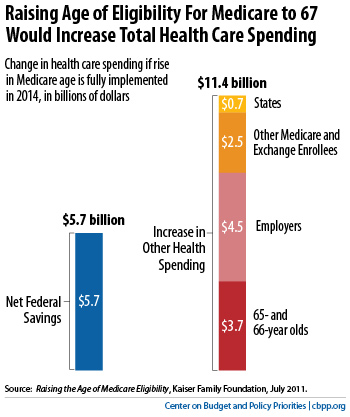
View the full report at: http://www.cbpp.org/cms/index.cfm?fa=view&id=3564 or http://www.cbpp.org/files/8-23-11health.pdf 7pp.

 CMA Health Policy Blog